
Malic Acid

Medchemexpress LLC Malic acid disodium salt | 676-46-0 | MFCD00012466 | 98.0% | 178.05 g/mol | C4H4Na2O5 | 10 G

Malic acid disodium salt is the disodium salt of malic acid, provided as a white crystalline powder suitable for use as a buffering agent, pH regulator, food additive, and biochemical reagent for in vitro research and analytical applications.
- White crystalline powder, soluble in water.
- Function as a buffering agent and pH regulator in biochemical assays.
- Useful as a food additive and nutritional supplement ingredient.
- Molecular formula C4H4Na2O5; molecular weight 178.05 g/mol; CAS 676-46-0.
- Typical purity 98.0% as supplied for laboratory use.
- Available in small laboratory pack sizes for analytical workflows.

Medchemexpress LLC S-malic acid-13C4 | 150992-96-4 | 98.0% | 138.06 g·mol⁻1 | 13C4H6O5 | 10mg
(S)-Malic acid-13C4 is the 13C labeled S-Malic acid (HY-Y1069)[1]
![Medchemexpress LLC 3-[4-(4-hydroxyphenyl)piperazin-1-yl]-1-phenylpyrrolidine-2,5-dione | 522649-59-8 | 99.7% | 351.4 g/mol | C20H21N3O3 | 10MM 1ML](https://assets.fishersci.com/TFS-Assets/CCG/product-images/5000238829.png-250.jpg)
Medchemexpress LLC 3-[4-(4-hydroxyphenyl)piperazin-1-yl]-1-phenylpyrrolidine-2,5-dione | 522649-59-8 | 99.7% | 351.4 g/mol | C20H21N3O3 | 10MM 1ML
Malic enzyme inhibitor ME1 is a small-molecule research reagent that inhibits cytosolic malic enzyme 1 (ME1) with a reported IC50 of 0.15 μM. The compound is supplied in ready-to-use solution formats for in vitro assays and is provided with supporting documentation for safe handling and quality verification.
- Potent ME1 inhibitor (IC50 0.15 μM).
- Supplied as 10 mM solution in DMSO, ready for in vitro use.
- High purity (≈99.7%) with certificate of analysis available.
- Soluble in DMSO up to 100 mg/mL; warming can improve solubility.
- Storage stability information provided for powder and solution formats.
- Documentation includes SDS, COA, and product data sheet for handling and quality details.

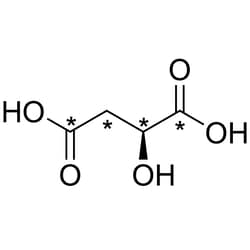

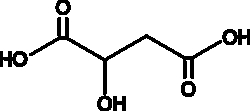
Cayman Chemical DL-MalIc AcId 250g
The racemate of L-malic acid; reduces IFN-γ and TNF-α-induced CCL2 and ICAM expression in HaCaT human keratinocytes at 1 mM; inhibits epidermis and dermis thickening, as well as mast cell and eosinophil dermal infiltration in a mouse model of DNBC-induced atopic dermatitis at 10 mM
Medchemexpress LLC DL-malic acid | 6915-15-7 | MFCD00064212 | 99.8% | 134.09 g·mol⁻¹ | C4H6O5 | 100g
Malic acid (Hydroxybutanedioic acid) is a dicarboxylic acid that occurs naturally in fruits like apples and pears with oral activities Malic acid plays a role in many sour or tangy foods Malic acid is an intermediate in the citric acid cycle[1][2]

Medchemexpress LLC (S)-Malic acid | 97-67-6 | MFCD00064213 | 99.6% | 134.09 g/mol | C4H6O5 | 25mg
(S)-Malic acid (Standard) is the analytical standard of (S)-Malic acid This product is intended for research and analytical applications (S)-Malic acid ((S)-2-Hydroxysuccinic acid) is a dicarboxylic acid in naturally occurring form contributes to the pleasantly sour taste of fruits and is used as a food additive In Vitro It is showed that ME is essential for (S)-2-Hydroxysuccinic acid (L-malic acid) utilization in L casei Furthermore deletion of either the gene encoding the histidine kinase or the response regulator of the TC system resulted in the loss of the ability to grow on (S)-2-Hydroxysuccinic acid thus indicating that the cognate TC system regulates and is essential for the expression of ME Transcriptional analyses shows that expression of maeE is induced in the presence of (S)-2-Hydroxysuccinic acid and repressed by glucose whereas TC system expression is induced by (S)-2-Hydroxysuccinic acid and is not repressed by glucose[1]
Chem-Impex International, Inc. L-Malic acid | 97-67-6 | MFCD00064213 | 100G
L-Malic acid, 97-67-6, MFCD00064213, 100G
Chem-Impex International, Inc. L-Malic acid | 97-67-6 | MFCD00064213 | 5KG
L-Malic acid, 97-67-6, MFCD00064213, 5KG